Monday, May 21, 2012
Spurgeon on the Puritans
In 1872, Spurgeon said, "We assert this day that, when we take down a volume of Puritanical theology we find in a solitary page more thinking and more learning, more Scripture, more real teaching, that in whole folios of the effusions of modern thought. The modern men would be rich if they possessed even the crumbs that fall from the table of the Puritans."


Tuesday, May 15, 2012
Joseph Alleine's Useful Questions for Self-examination
Useful Questions for Self-examination adapted from Joseph Alleine
Ps. 4:4 Commune with your hearts upon your beds.
Duties
Was I sleeping when I should have been praying? Ps.5:3
Have my prayers been full of wandering thoughts? Jer 12:2
Have I neglected or read God's Word to not profit?Deut. 17:19
Have I digested the last sermon I heard? Have I repeated it and prayed over it? Ps.1:2
Have I denied myself in any way this day for God? Luke 9:23
Have I overslept in a world full of needs? Col.4:5
Have I been selective about whose company I keep, including characters in the movies I watch and books I read? Prov.13:20
Have I neglected some duty or sinned against my parents or siblings? Eph.6:1-3
Sin
Do I lightly brush off my sins? Ps.38:4
Do I mourn for the sins of the land? Ez.9:4
Do I refrain from doing what I know or fear to be sin? Ps.119:101,104
Heart
Have I prayed thoughout the day? Neh.2:4,5
Has God been far from my thoughts? Ps.16:8
Have I disciplined my thoughts? Ps.119:113
Have I nurtured pride or wrong passions? James 4:5-7
Tongue
Have I bridled my tongue? James 1:26
Have I spoke evil of no man? Titus 3:2
Has the law of the Lord been in my mouth as I sat in my house, went by the way, was lying down and rising up? Deut.6:6,7
When I have talked to people, have I said something of God and left some good savor behind? Ep.4:29
Table
Did I sit down with a higher purpose than a pig at the trough (i.e.to fill my stomach); did I eat and drink for the glory of God?
1 Cor.10:31
Did I eat more than I needed to? 2 Peter 1:6
Did I participate in the dinner conversation with no mention of God? Luke 7:36ff; 19:1ff
Was I merely going through the motions when I asked God's blessing and gave thanks for the food? Col.3:17
Calling
Did I work hard?1 Cor.7:17
Did I cheat anyone? 1Thes.4:6
Did I lie? Ep.4:25
Did I make promises and not keep them? Ps.15:4
I am aiming for 1,000.
Inspired by Ann Voskamp's One Thousand Gifts, I am listing things that I am thankful for. I hit 261 yesterday. I like this discipline because it gives me practice in something I do very poorly on my own.
Here are some of my latest entries:
249 red tulips and Abdullah chocolates for Mother's Day
250 my weakness and fear draws out your sympathy, Lord.
254 lily of the valley in a small canning jar
255 sleep on the couch to mend my deep weariness after Abigail's surgery to remove tonsils and adenoids
256 sore leg to remind me of my frailty
257 Joseph Alleine's Useful Questions to direct my repentance (see next post)
261 new granola recipe
Here are some of my latest entries:
249 red tulips and Abdullah chocolates for Mother's Day
250 my weakness and fear draws out your sympathy, Lord.
254 lily of the valley in a small canning jar
255 sleep on the couch to mend my deep weariness after Abigail's surgery to remove tonsils and adenoids
256 sore leg to remind me of my frailty
257 Joseph Alleine's Useful Questions to direct my repentance (see next post)
261 new granola recipe
Envy and I have been friends too long....
In any discussion about taking dominion, the first battle ground is our own hearts. Solomon said "Above all else, guard your heart, for it is the wellspring of life."
We all know of powerful leaders who had no self control. Alexander the Great is said to have drunk himself to death, Hitler was obsessed with chocolate cherries (liqueur-filled), and many politicians have straying eyes and hearts.
This is a huge topic, but no small issue of our heart involves thankfulness. Here I'm going to talk about one of its opposites: envy.
Recently, one of my favorite bloggers, Tim Challies, admitted that he has had a long friendship with envy. The discovery surprised him. It disgusted him. He went on to describe the discovery of envy in himself and in Biblical characters, and God's view of it, how envy behaves and then the desires of envy, and how to kill it.
Webster's defines envy this way:
To feel uneasiness, mortification or discontent, at the sight of superior excellence, reputation or happiness enjoyed by another
I confess that I have made the same foolish choice of friends. Though I did not see it, my envy was in coveting the leadership of men other than my husband. I would read on family life and think that we should order our home in the same way. I told my husband so. As you can imagine, he received this as criticism after criticism; a huge vote of no confidence. Finally he asked me to stop reading those books unless we could read them together.
One book he might not have minded me reading and studying is Shawn Lantz' Bible Study called Living with Unmet Desires.

Using biblical characters, Shawn exposes the many faces of envy or jealousy. Because sin cripples and paralyzes us, it needs to be exposed. And confessed. Shawn takes us deep by identifying four core issues of a jealous heart:
- God, can I trust You?
- God, do You love me?
- God, are You good?
- God, are You just?
Ask yourself what you believe about God. If you want to go deeper, study the Bible. There we see God and ourselves more clearly, and we learn to trust and know God better. Listen to the testimony of Shawn Lantz:
Oh, my sweet friend, God's Word has absolutely changed my life. His Word is the biggest delight of my life. It has brought me such healing in so many places---places I didn't even know needed healing. I respected Christ before, I was even afraid of Him and His wrath, but I have since fallen in love with Him.... It's the only relationship I have that gives me more to give to everyone else. I can never get to the bottom of Him. He is the most exciting, creative, beautiful, romantic, holy Being I have ever encountered and I am crazy about Him.
I am thankful that God exposed my ungratefulness and envy, and gave me grace to see things from my husband's perspective. Envy and I have been friends too long and I am plotting murder. If I am to rule my home well, God must be my portion. No one satisfies like him. Discontent comes from wanting people to be God to me. And intense joy comes in trusting that it is in perfect wisdom and justice that God has ordered my life. He has gracious, eternal purposes in calling me to rule in this house, with this good man, and these dear children.
Taking dominion starts with keeping the heart. For God.
Tuesday, April 24, 2012
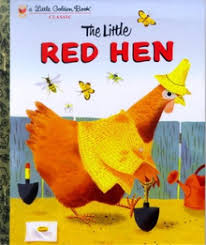
The Little Red Hen and Welfare
I recently blogged on this subject
YOU ARE HERE: HOME / VISIONARY CULTURE CHANGERS / THE LITTLE RED HEN AND WELFARE
YOU ARE HERE: HOME / VISIONARY CULTURE CHANGERS / THE LITTLE RED HEN AND WELFARE
The Little Red Hen and Welfare
BY CONTRIBUTING WRITER, JEANNETTE PAULSON
You can use children’s stories to teach complicated but important truths about welfare. Take, for example, the hard-working Little Red Hen.
The Little Red Hen believes the proverb, “He who does not work shall not eat.” In the story, we see her heroically planting, tending, harvesting and preparing wheat all by herself. At the end, she and her chicks enjoy the warm bread. The idle dog, cat and turkey smell the fresh bread, but don’t receive a crumb.
Ask your child what would happen the next spring when it is again time to plow and sow. Will the dog, cat and turkey sit idle? They will run for their hoe and get busy. The Bible says “The working man’s hunger drives him on.”
As a twist, let’s think of a different plot. Watch the Little Red Hen setting the steaming loaf on the table before her chicks. Suddenly the farmer bursts in. Seeing the dog, cat and turkey drooling in the corner, he shouts, “Little Red Hen, give them their fair share.” Reluctantly cutting the loaf in fourths, the Little Red Hen passes it out.
Now what do you think will happen in the spring? The incentive to work has been destroyed. Soon the farm will be impoverished. When the farmer cannot satisfy everyone, there will be protests.
Now let us say that the Little Red Hen represents the family and the farmer is the government.
R.J. Rushdoony says,
The family is a God-ordained institution and one of its basic functions is welfare.
Scripture teaches this. Jesus did not want any gifts from people who were neglecting to care for their parents. And Paul says that one who does not provide for his own household is worse than an unbeliever. To new believers he says they should steal no more but work with their hands to give to those in need.
Further, let us learn from history. Rushdoony says,
No system devised by man or the state can ever replace the family in its efficiency and success in creating social stability and strength while supporting and educating virtually all the children of the land. [In contrast, the] state system of welfare has in every age been productive of social disorder and delinquency.
By providing welfare, the state, God-like, promises to provide for all needs. But it cannot. Then the disappointed pick up stones. The “welfare mobs” of Rome became increasingly difficult to satisfy. Because of this difficulty, emperors moved the capital from Rome to Constantinople and then split it also to reside in Ravenna.
Do these mobs sound eerily familiar? Holland, Greece, France, and the United States have these welfare mobs too.
Rushdoony warns,
We are penalizing responsibility and subsidizing irresponsibility, and, in the process, inviting God’s judgment.

Greek demonstrators throw fire bombs at riot police during violent protests in Athens.Photograph: Milos Bicanski/Getty Images
Use the Little Red Hen to teach your children that God has put the family in charge of welfare. Teach them to be content and hard-working. Teach them to fear God and be generous. You will bless all of society.
It is right that the Little Red Hen enjoy her steaming wheat bread with her chicks. There are more hoes in the shed, and no reason why the dog, the cat and the turkey shouldn’t enjoy a steaming load of their own.
Thursday, March 29, 2012
When hatred is right.
Richard Sibbes gives six reasons for hating sin:
".... hatred is a more rooted affection than anger; anger may be appeased, but hatred is against the whole kind."
http://www.challies.com/quotes/hate-it-from-the-heart?utm_source=feedblitz&utm_medium=FeedBlitzEmail&utm_campaign=Four-hourly_2012-03-25+12%3A15&utm_content=5575
".... hatred is a more rooted affection than anger; anger may be appeased, but hatred is against the whole kind."
http://www.challies.com/quotes/hate-it-from-the-heart?utm_source=feedblitz&utm_medium=FeedBlitzEmail&utm_campaign=Four-hourly_2012-03-25+12%3A15&utm_content=5575
The cure for self-pity
An audio series we purchased recently had some sobering words about self-pity and gives incentives for living in faith with resolve. I blogged on it here:

BY CONTRIBUTING WRITER, JEANNETTE PAULSON
Our youngest daughter has thoroughly enjoyed doing her dishes ever since an audiobook series called “Voices from the Past” came in the mail. This series, read by Victoria Botkin, features five different women from America’s past. The stories are gripping with both humor and heartbreak, but I want to look at what they teach about self-pity, faith and resolution.
SELF-PITY
Self-pity is resigning ourselves to the difficulties of life without hope of deliverance. Job said, “Man is born to trouble as the sparks fly upward.” We should expect difficulty. But where can we take refuge in the storm?
Nanny Alderson, who had her dream home burned to the ground by Indians, warns of the danger of self-pity:
I was beginning to feel sorry for myself, the lowest state which a woman’s mind can fall.
Another women, Elinore Stewart, widowed with a young daughter, went west to homestead. She says,
…when we become sorry for ourselves we make our misfortunes harder to bear because we lose courage. We can’t think without bias.
If you could watch yourself as you watch a play, would you like the character you are? Nobody likes a cowardly, sniveling, half-hearted, self-pitying character. Rather, we love a character who rises above his circumstances, is persistent, faithful, hopeful, courageous and energetic. We love a character who does right even when everyone around is doing wrong.
However, if we are full of self-pity, how will we be rescued?
FAITH
Faith is the assurance of things hoped for, the conviction of things not seen (Heb.11:1)
We must have faith.
Either all we have is here and now, and then there is a lot to feel sorry about… or there’s the possibility of a glorious afterlife that makes everything today look different.
Only God can give us eyes to see the power, beauty and grace of Christ who can deliver us from the greatest of storms — the wrath of God that we are under because of our sin. Only Christ can remove our sin and secure our eternal rest.
Seeing differently, we act differently. Now we can move from the defeat and hopelessness of self-pity to the hope and purpose of living by faith. In Him we are adopted, empowered and given glorious work. And his compensations for our labors , though mostly delayed, are outrageously generous.
This faith steels our resolve.
RESOLVE
Having resolve is having fixed purpose of mind, settled determination.
Puritan Thomas Brooks had that faith that steels resolve:
Your life is short, your duties many, your assistance great and your reward sure; therefore faint not, hold on and hold up, in ways of well-doing, and heaven shall make amends for all.
Eliza Pinckney is another women featured in “Voices from the Past.” She had faith, and it made her energetic and creative in the face of heavy trials. In the absence of her father, while caring for a sick mother, Eliza managed three plantations, developed a highly marketable dye, and planted an oak grove for future ship building. Every morning she would read a list of resolutions she had written. I cannot resist sharing a few excerpts.
She is careful of her doctrine:
I am resolved to believe in God; that he is, and is a rewarder of all that diligently seek him….to believe in him, to fear him and love him with all the powers and faculties of my soul. To keep a steady eye to his commands, and to govern myself in every circumstance of life by the rules of the gospel of Christ…
She purposes not to be anxious:
I am resolved by the Divine will, not to be anxious of doubtful, not to be fearful of any accident or misfortune that may happen to me or mine, not to regard the frowns of the world, but to keep a steady upright conduct before my God, and before man, doing my duty and contented to leave the event to God’s Providence.
She is careful of her heart:
I will not give way to any the least notions of pride haughtiness, ambition, ostentation, or contempt of other. I will not give way to envy, ill will, evil speaking, ingratitude, or uncharitableness in word, in thought, or in deed, or to passion or peevishness, nor to sloth or idleness, but to endeavor after all the contrary virtues, humility,charity, etc, etc, and to be always usefully or innocently employed.
She purposes to be a faithful wife:
To pray for [my husband], to contribute all in my power to the good of his Soul and to the peace and satisfaction of his mind, to be careful of his health, of his interests, of his children, and of his reputation; to do him all the good in my power; and next to my God, to make it my study to please him.
To read the complete list of resolutions, go here.
Seeing the courage of these pioneer women in the middle of crushing hardship make me ashamed of my self-pity. They inspire me to walk by faith and to persevere.
And listening to their stories makes doing dishes much more fun.
Subscribe to:
Posts (Atom)